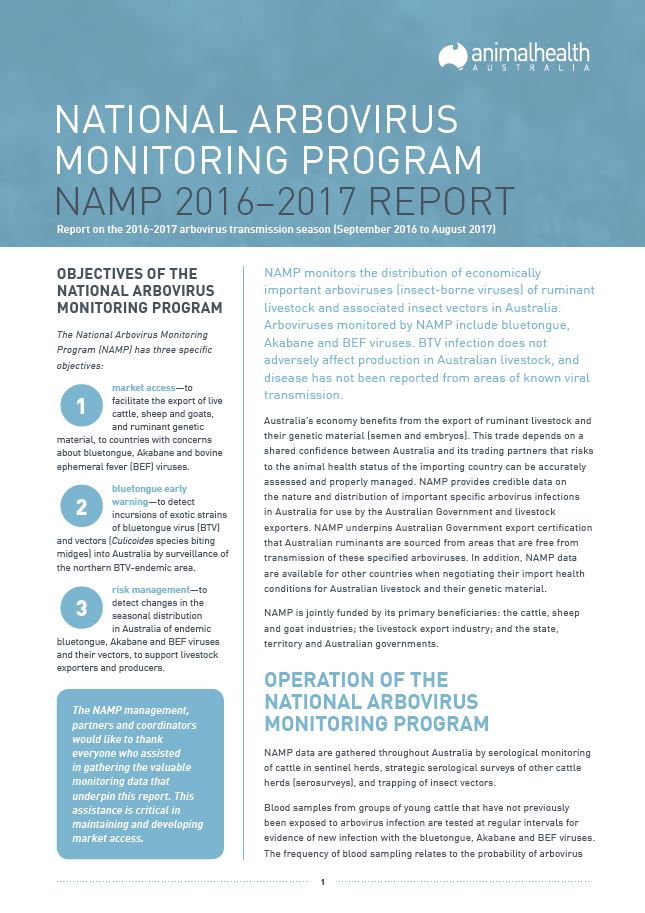
The National Arbovirus Monitoring Program (NAMP) monitors the distribution of economically important arboviruses (insect-borne viruses) of ruminant livestock and associated insect vectors in Australia.
Arboviruses monitored by NAMP include bluetongue, Akabane and bovine ephemeral fever (BEF) viruses.
By monitoring arboviruses in Australia, we can help maintain access to arbovirus sensitive markets while providing credible disease risk management data.
NAMP objectives
Market access
To facilitate the export of live cattle, sheep, goats and camelids, and their reproductive material, to countries that apply import conditions to mitigate the risk of introduction of bluetongue, Akabane and bovine ephemeral fever (BEF) viruses.
Bluetongue early warning
To detect incursions of exotic strains of bluetongue virus (BTV) and vectors (Culicoides species biting midges) that have the potential to adversely affect livestock production in Australia and trade by surveillance of the northern BTV-endemic area.
Risk management
To detect changes in the seasonal distribution in Australia of endemic bluetongue, Akabane and BEF viruses and their vectors, to inform livestock producers and support trade.
How we collect data
NAMP data is gathered throughout Australia by serological monitoring of cattle in sentinel herds, strategic serological surveys of other cattle herds (serosurveys), and trapping of insect vectors. The program maintains a database management system and publishes an annual report.
The NAMP is an ongoing collaboration between its primary beneficiaries: the cattle, sheep and goat industries; the livestock export industry; and the state, territory and Australian governments.
Bluetongue virus and international trade – why the “viraemic period’ matters
- The viraemic period for economically important arboviruses is an important consideration for trade of Australian ruminant livestock to overseas countries.
- The duration of viraemia (viraemic period) is defined as the length of time that viral replication and dissemination can occur in the bloodstream, providing a ‘window’ of time that insect vectors can transmit arboviruses from an infected animal to another susceptible host.
- The viraemic period for bluetongue virus can extend for up to 60 days in infected livestock, which is why many overseas countries include restrictions on account of bluetongue virus in their trade protocols.
- However, the duration of viraemia for Akabane and bovine ephemeral fever viruses is limited to six and five days, respectively, so there is less risk of transmission from Australia of bovine ephemeral fever virus or Akabane virus to susceptible livestock species overseas.
Limits of bluetongue virus transmission
The limit of BTV transmission in Australia is shown on the Bluetongue Virus Interactive Zone Map. The map defines the areas in which no viral transmission has been detected for the past two years. Viral transmission is defined as detection of evidence of viral infection based on serological monitoring of cattle.
Annual reports
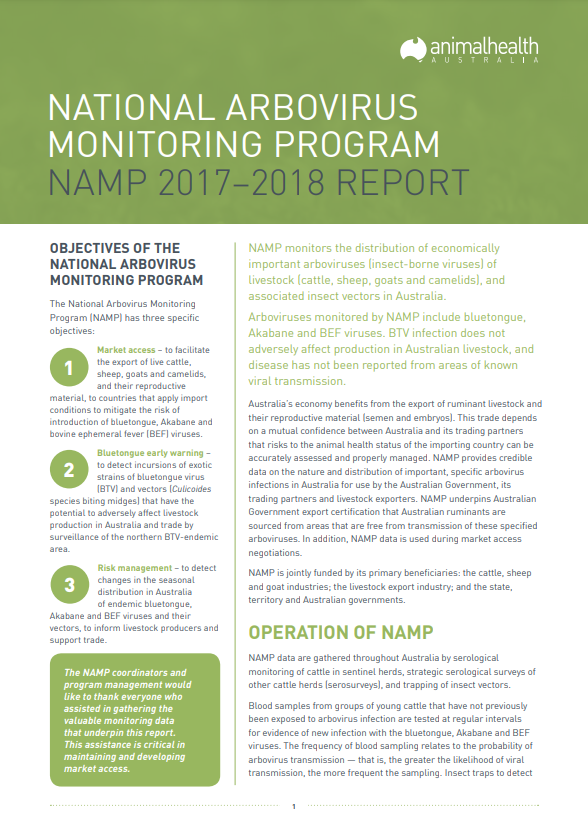
To subscribe to future NAMP annual reports, contact publications@animalhealthaustralia.com.au or fill out our subscribe form.