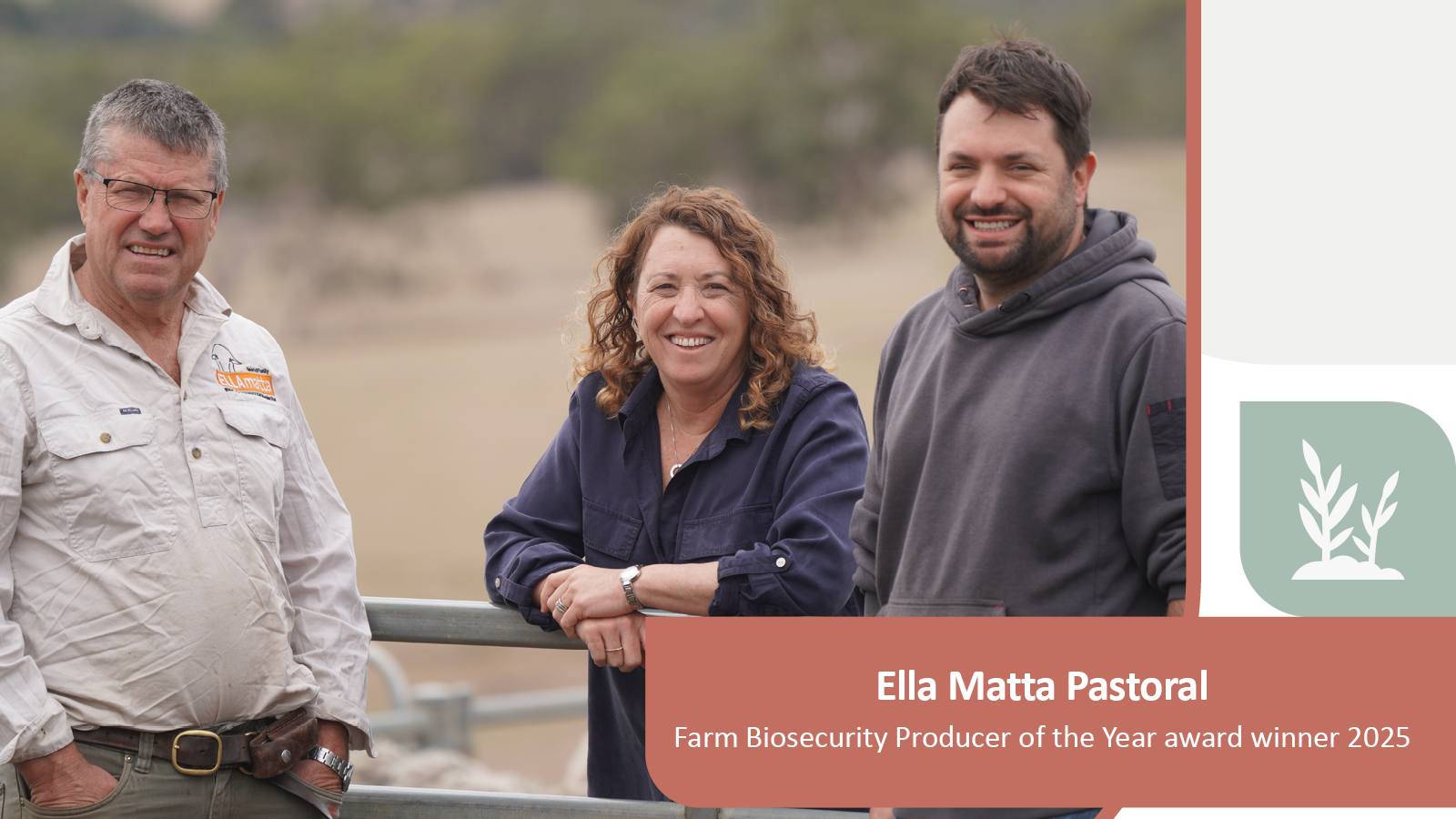
When Jamie Heinrich talks biosecurity, he doesn’t talk burdens, red tape, or checklists. Instead, his focus is on responsibility and the obligation to protect the livestock, land and community that his family has stewarded for generations.
‘To me, biosecurity is a no‑brainer. It’s about protecting everything we do,’ he says. ‘You can’t control everything, but you can minimise the risk.’
This clarity of purpose is why Ella Matta Pastoral — run by Jamie, his father Andrew, and mother Tracie — was named Farm Biosecurity Producer of the Year at the 2025 Australian Biosecurity Awards. The national award recognises producers who set new standards in proactive, practical biosecurity, and Ella Matta’s approach is now widely regarded as among the strongest and most consistent in Australia.
A high‑performance enterprise built on discipline
Located on Kangaroo Island, Ella Matta Pastoral operates across 900 hectares of arable land and 300 hectares of native vegetation.
The farm runs a pasture‑based system built on sub‑clover, ryegrass, cocksfoot, phalaris and kikuyu, with around 40% of its arable land sown to kikuyu to provide resilience during dry spells.
Breeding season is busy on the farm, with hundreds of ewes moving through the yards as part of a carefully planned program. Artificial insemination has become routine — around 1,300 ewes are bred this way each year — and an embryo transfer program helps the Heinrichs fast‑track the best genetics they’ve worked so hard to develop.
‘We’re always trying to improve the flock, but never at the expense of their wellbeing,’ says Jamie. ‘We think of our sheep as our employees. If we take care of them, they’ll take care of us.’
They now sell more than 500 rams annually, which makes biosecurity not just a production priority, but essential to the business.
‘Buyers want good genetics and healthy sheep, so we need to minimise the biggest risk — bringing in outside animals,’ Jamie explains.
That philosophy is why Ella Matta has maintained a closed flock for more than 25 years, bringing in new genetics only through artificial insemination and embryo transfer. This single decision significantly reduces exposure to endemic and emerging diseases and underpins every other part of their biosecurity plan.
It’s a long‑term commitment that sets clear boundaries for the farm and clear expectations for anyone interacting with it.
Farm entry: make the right thing the easy thing
Visitors to Ella Matta encounter a clear, structured process: biosecurity and safety inductions, footwear protocols and vehicle wash‑downs. These systems are notable not for their complexity but for their practicality.
Jamie says a surprising win was providing dedicated Ella Matta boots for regular visitors and contractors. What initially felt logistically difficult turned out to be simple and effective.
‘We thought it would be painful, but now it’s the easiest thing ever. It’s easier than getting people to step in a footbath. They rock up, we swap their boots out. Done.’
Vehicles follow a similar rule. External vehicles must go through the farm’s wash‑down bay, where tyres and risk‑prone areas are pressure cleaned. With the right infrastructure, Jamie says, ‘it really doesn’t take that long, and it’s not hard.’
Sale day: 200 visitors, one gate, zero compromise
Ella Matta’s annual ram sale attracts up to 200 visitors in a single day, posing a significant biosecurity challenge. Yet it’s also become one of the clearest demonstrations of the farm’s leadership.
All visitors enter through one approved gate, where their boots are checked and cleaned. Once completed, visitors are issued a wristband — a simple visual indicator that they have met entry requirements.
Jamie admits the family worried about how this would be received. Would buyers find it frustrating? Would it feel like a barrier to doing business? The opposite occurred.
‘We’ve actually flipped the culture,’ he says. ‘Most people see it as a positive and like that we’re doing it properly. The handful who don’t like it are outnumbered, and everyone stirs them up if they rock up unprepared.’
The system has become so normalised that many frequent visitors now swap their boots or wash vehicles upon arrival, unprompted.
Fencing, feed and contingency thinking
Biosecurity at Ella Matta continues well beyond the front gate. The business invests in strong boundary fences to limit wildlife interaction and place equal importance on maintaining internal fencing to separate stock classes and risk areas.
Feed is another key pillar. The Heinrichs grow their own hay, source purchased grain only from trusted suppliers, and confine potentially risky feed to controlled areas. When bushfire pressures forced the purchase of straw that might contain weed seeds, they restricted it to drought lots where monitoring was simpler.
This approach made a big difference recently when the family discovered three‑corner jack weed in purchased hay.
‘Ideally, we didn’t want to bring in hay, but we had a plan in place,’ Jamie says. ‘That made dealing with the issue much easier.’
Learning from others and leading by example
Jamie’s leadership extends beyond the farm. As a seventh‑generation farmer, LambEx Taskforce Chair and former board member for several national producer groups, his perspective is informed by broad experience.
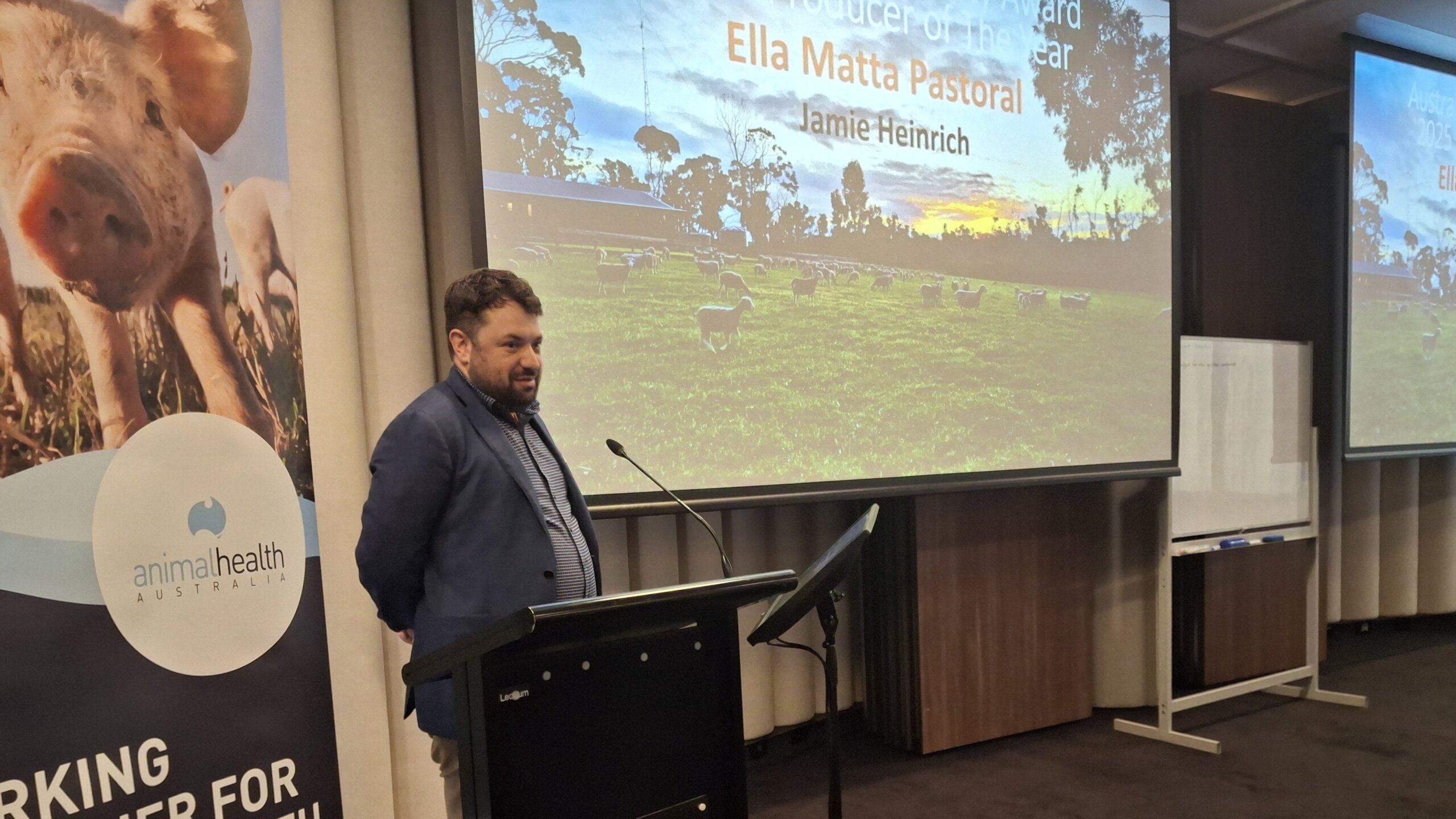
He says biosecurity advocacy matters because while government and industry set broad policy, ‘farmers are the ones on the front line.’ The goal is to find a balance between workable policies and realistic expectations.
‘If we have too many rules that aren’t practical, people just don’t do it. On the other hand, if you have a free‑for‑all, people won’t do anything either. You have to find the middle ground. Biosecurity isn’t about perfection — it’s about minimising risk in the easiest way possible.’
Kangaroo Island: a community advantage
Kangaroo Island provides a unique environment for strong biosecurity. The island has successfully eradicated feral pigs, deer and goats, with blowfly and feral cat eradication projects ongoing. It also has led the country in successful footrot and Johne’s disease management and eradication programs.
The tight‑knit local producer community — with around 600,000 sheep — is another asset.
‘It’s a unique community,’ Jamie says. ‘Everyone around us runs sheep or something similar. And because it’s a very defined area, it’s easier to bring projects onto the island and represent farmers clearly.’
Recognition that reinforces the message
Winning the 2025 Farm Biosecurity Producer of the Year award has been a proud moment for the Heinrich family, but Jamie is clear: it hasn’t changed how they operate.
‘We were always going to do it,’ he says. ‘But being recognised for it is pretty cool.’
Jamie remains upbeat about the future of the sheep industry. Global demand for red meat is rising, labour efficiency is improving, and genetic and genomic tools are advancing.
‘I don’t plan on going anywhere,’ he says. ‘I’m excited about the industry and the opportunities ahead.’
For Ella Matta Pastoral, the future is built on the same foundations that earned them national recognition: plan well, act early and make biosecurity simple, consistent and non‑negotiable.
Help celebrate the people protecting Australia’s future
The Australian Biosecurity Awards highlight the producers, innovators and communities who go above and beyond to safeguard our agriculture and environment. If you know someone whose work deserves recognition, explore the full list of award categories and consider nominating them.
Nominations open 5 May 2026.