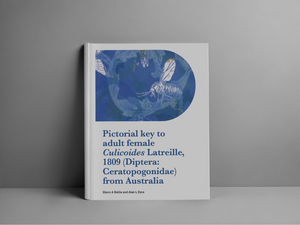
A new publication from the National Arbovirus Monitoring Program (NAMP) will strengthen Australia’s arbovirus surveillance and biosecurity capability by providing the first comprehensive identification guide for female Culicoides biting midges found in Australia.
The Pictorial key to adult female Culicoides Latreille, 1809 (Diptera: Ceratopogonidae) from Australia brings together extensive taxonomic knowledge, surveillance data and field experience into a practical resource for biosecurity officers, entomologists and surveillance personnel.
The publication is the first identification aid to cover female specimens of all Culicoides species recorded in Australia, as well as several exotic species considered important from a biosecurity perspective.
For those working on the frontline of surveillance, the guide provides a practical tool to support the detection of new species incursions and changes in the distribution of established species.
A resource years in the making
The publication represents the culmination of a long-term effort involving researchers, surveillance specialists and government agencies across Australia.
Building on earlier foundational works, including the Pictorial Atlas of Australasian Culicoides Wings published by Dyce and colleagues in 2007 and a regional identification key developed by Bellis and colleagues in 2015, the new guide expands coverage to species occurring across mainland Australia and Tasmania.
Its development drew on thousands of specimens collected over many years through NAMP and related surveillance activities, creating a resource grounded in real-world surveillance experience.
The project was funded through NAMP and supported by the program’s ongoing investment in reference entomology services, specimen collections and diagnostic expertise.
Why Culicoides matter
Culicoides biting midges are small blood-feeding insects that can transmit arboviruses affecting livestock. Accurate identification of these species is important for surveillance, preparedness and understanding disease risk.
Distinguishing between species is also critical for detecting exotic incursions that could alter the ecology and distribution of midge-borne diseases in Australia.
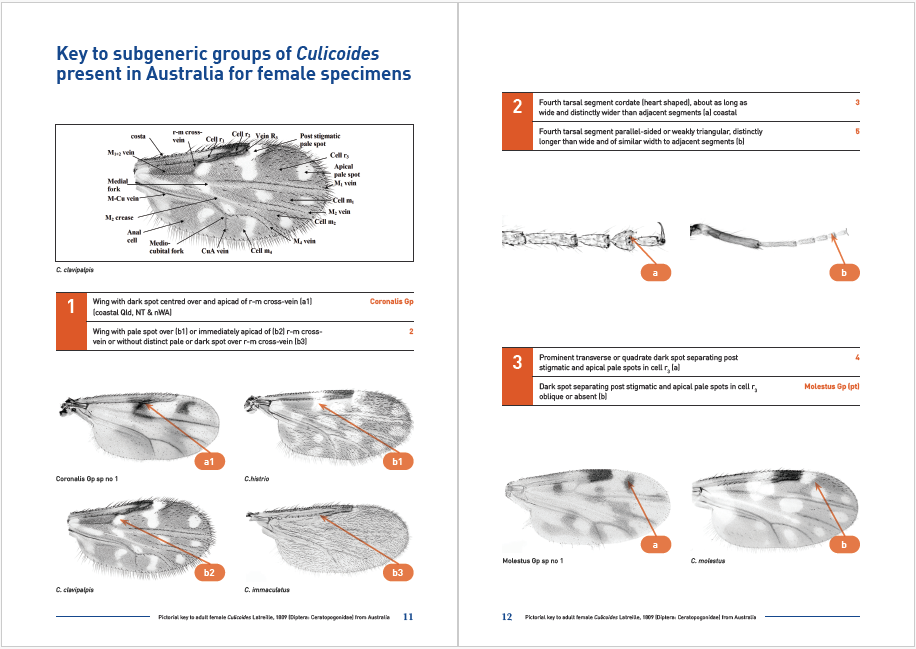
The guide addresses this challenge by providing a systematic approach to identifying female specimens using visible morphological features, supported by illustrations, species fact sheets, distribution information, and diagnostic characteristics.
Importantly, the resource focuses on female midges as they are most frequently collected during surveillance and play the most significant role in disease transmission.
By bringing together identification keys, supporting images, and biological information in a single reference, the publication gives surveillance and biosecurity personnel a practical tool to support more accurate and consistent species identification.
Supporting Australia’s biosecurity preparedness
One of the guide’s most valuable contributions is its practical application for surveillance and biosecurity programs.
The publication includes not only Australian species but also selected exotic species that could pose a significant risk if introduced and established in Australia.
By enabling more consistent and accurate identification, the guide supports early detection efforts and strengthens Australia’s preparedness for emerging vector-borne disease threats.
It also provides a common reference point for government agencies, laboratories, researchers and surveillance teams working across jurisdictions.
The guide goes beyond a traditional identification key. It includes species fact sheets, illustrations, distribution maps and biological information that help users validate identifications and build confidence in their results.
Together, these resources provide a comprehensive reference for those involved in vector surveillance and biosecurity.
Fulfilling a long-held vision
The publication also fulfils a vision decades in the making.
For renowned Australian entomologist Alan Dyce AM, developing an identification key that captured the full diversity of Australia’s Culicoides fauna was a long-held ambition. Although he passed away before the project was completed, his research, specimen collections, illustrations, unpublished notes and long collaboration with co-author, Glenn Bellis, helped lay the foundation for the work that followed.
The finished publication stands as both a practical surveillance tool and a tribute to one of the scientists who helped shape Australia’s understanding of biting midges and their role in animal health. It also reflects the contributions of the many researchers, surveillance specialists and technical experts who built on that foundation to bring the project to completion.
A testament to collaboration
The guide’s significance extends beyond its scientific value.
Its development relied on contributions from researchers, field collectors, diagnosticians, laboratory staff, and surveillance personnel from across Australia. NAMP-collected specimens formed a critical part of the work. At the same time, experts from government agencies and research institutions helped test and refine the keys to ensure they met the needs of their intended users.
Workshops involving midge researchers and surveillance specialists from multiple jurisdictions provided valuable feedback that helped improve the final publication and ensure its practical application in the field.
The result is more than an identification guide — it’s a shared national resource that captures decades of knowledge, experience and surveillance effort.
As Australia continues to face evolving biosecurity challenges and vector-borne disease risks, resources like this will play an increasingly important role in supporting early detection, informed decision-making, and national preparedness.
Download a copy
Download your copy of the Pictorial key to adult female Culicoides Latreille, 1809 (Diptera: Ceratopogonidae) from Australia today.